



Company News
Company News
How to solve the warping and deformation problem during the lamination process of high-level HDI boards?
Author:RUNMTEK
Publication Date:2026-01-07
Page Views:28
Accurately match materials to reduce interlayer stress from the source
High-level HDI boards are mostly multi-layer structures, composed of core boards, prepreg (PP), and other different materials laminated together. The mismatch in coefficient of thermal expansion (CTE) is the core root cause of warpage.
Preferentially choose material combinations with low CTE and good compatibility: For example, use modified BT resin or PI material for the core board, paired with low-flow prepreg of the same system, to narrow the CTE difference between the core board and PP; for ultra-thin substrates (thickness < 0.1mm), thinner core boards with stronger rigidity can be selected to enhance the substrate's own resistance to deformation.
Strictly control the moisture content and pre-drying treatment of materials: The core board and PP need to undergo high-temperature pre-drying (such as 120°C/2h) before lamination to remove internal moisture and avoid interlayer bubbles and uneven stress caused by moisture vaporization during lamination.
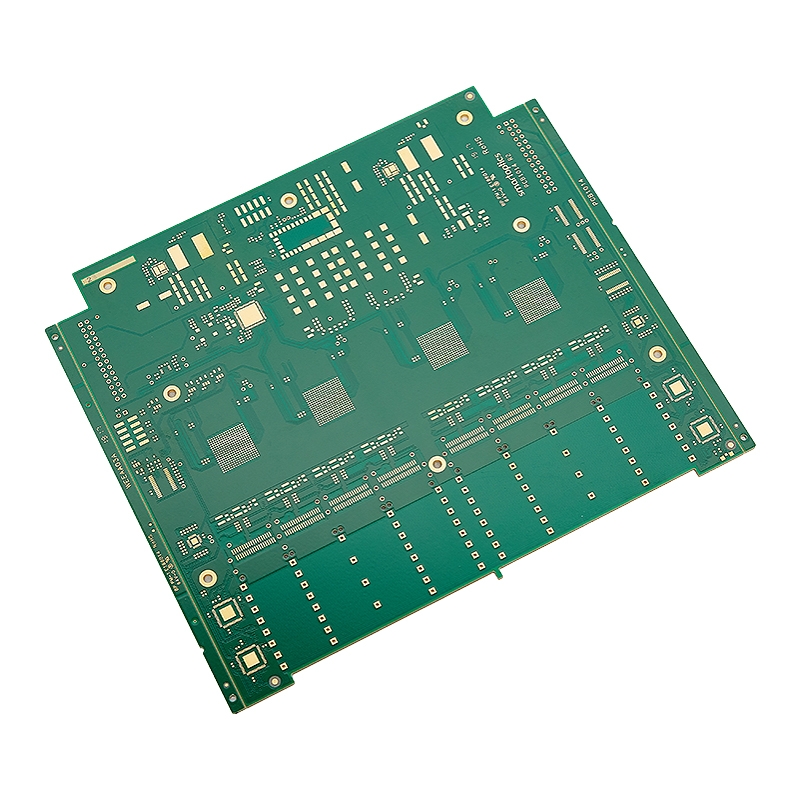
Optimize the lamination process parameters to reduce stress accumulation during the hot pressing process
The temperature, pressure, and rate of temperature increase and decrease during lamination directly affect the stress distribution of the substrate and are key factors in controlling warpage.
Adopt a step-wise temperature/pressure increase and decrease curve: Avoid rapid temperature and pressure increase, which can lead to uneven heating and pressure on the material. For example, the temperature increase stage can be divided into 3 sections (50℃→100℃→170℃), with each section maintaining a constant temperature to allow the resin to fully melt and flow; during the pressure increase stage, gradually apply pressure (from 0.5MPa to 3.0MPa) to ensure tight layer bonding and uniform stress.
Precisely control the holding time for heat and pressure: If the time is too short, the resin in the prepreg will not be fully cured, resulting in weak interlayer bonding; if the time is too long, the resin will undergo excessive crosslinking, increasing its brittleness and susceptibility to warping. The optimal parameters (such as 170°C/90min) need to be determined through experimentation based on the thickness of the substrate and the type of material.
Adopting a double-sided symmetrical pressing design: During pressing, symmetrical steel plates and cushioning materials are selected to ensure that the upper and lower surfaces of the substrate are heated and pressed uniformly, avoiding excessive stress on one side that could lead to warping.
Upgrade equipment and fixtures to enhance the stability of the lamination process
The precision of equipment and the design of fixtures directly determine the uniformity of lamination. Given the ultra-thin characteristics of high-level HDI boards, targeted upgrades are necessary:
Selection of vacuum laminator: Laminating in a vacuum environment reduces the generation of interlayer bubbles and simultaneously avoids local pressure impact on the substrate caused by thermal expansion of air.
Equipped with a high-precision alignment and leveling system: Before lamination, the layer deviation error is controlled within ±2μm through CCD visual alignment; during lamination, an elastic buffer pad with better leveling properties (such as a silicone pad) is used to offset minor irregularities on the steel plate surface, ensuring uniform stress on the substrate.
Using a carrier plate for assisted lamination: For ultra-thin substrates with a thickness of less than 0.08mm, attach them to a rigid carrier plate for lamination to prevent bending and deformation during the thermal lamination process. After lamination, remove the carrier plate.
Post-processing correction to repair minor warping and deformation
For minor warping (warping degree < 0.5%) that occurs after lamination, it can be corrected through post-processing techniques:
Hot pressing and leveling treatment: Place the warped substrate into a leveling machine and apply constant pressure (1.0–1.5 MPa) for 30–60 minutes at a temperature slightly below the resin curing temperature (such as 130°C), utilizing the secondary softening characteristics of the resin to eliminate internal stress.
Mechanical grinding and leveling: For substrates with warped surfaces, a small amount of material is removed from the surface using a precision grinding machine to achieve uniform thickness and meet warp standards. It is important to strictly control the amount of grinding to avoid damaging internal circuits.
Hot News
-
 What are the differences between rigid-flex PCBs and FPCs? Don’t mix them up anymore!2026-01-07
 -
 What exactly is the integration of hardware and software? Why are more and more products relying on it?2026-01-07
 -
 How to solve the warping and deformation problem during the lamination process of high-level HDI boards?2026-01-07
 -
 How can we overcome the technical difficulties in microvia processing for high-level HDI boards?2026-01-07