



Company News
Company News
How can the interlayer bonding strength of rigid-flex boards be ensured?
Author:RUNMTEK
Publication Date:2026-01-07
Page Views:32
Accurately matching materials can reduce the difficulty of interface adaptation from the source. The hard part of the rigid-flex board is mostly made of FR-4 and BT resin, while the soft part is made of polyimide (PI) substrate and copper foil. The interlayer bonding relies on prepreg (PP) or special adhesive film. The degree of material matching directly determines the bonding foundation.
Adhesive materials with good compatibility with PI substrates are preferred: ordinary FR-4 has poor adhesion between PP and PI, prone to delamination, and therefore requires the use of modified epoxy resin adhesive films or acrylic adhesive films. The molecular structure of these adhesive films can form chemical bonds with the PI surface, enhancing interfacial adhesion.
Control the coefficient of thermal expansion (CTE) difference between the substrate and the adhesive film: The CTE difference between hard and soft boards is significant, which can easily lead to interlayer delamination due to thermal stress during lamination and subsequent use. It is necessary to select an adhesive film with a low CTE to narrow the CTE gap with both hard and soft substrates and reduce stress accumulation during thermal cycling.
Strictly control material cleanliness: Residual oil stains and dust on the surface of adhesive films and substrates can directly cause bonding defects. Raw materials must be stored in a sealed manner, and surface cleaning must be conducted in a dust-free environment before use.
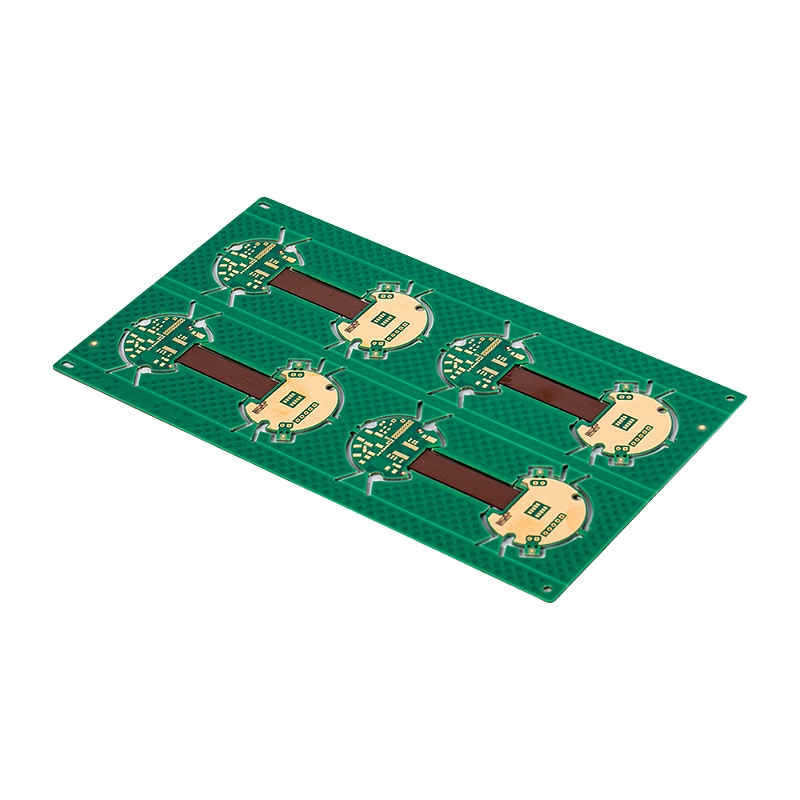
Enhance substrate pretreatment to improve surface activity and roughness. Soft and hard substrates have high surface smoothness and low activity, making it difficult to form a strong bond through direct lamination. It is necessary to increase surface roughness and activate chemical groups through pretreatment.
Pre-treatment of soft PI substrate: Plasma etching or sodium treatment is adopted. Plasma etching can etch tiny pits on the PI surface, increasing the specific surface area; sodium treatment can destroy the imide bond on the PI surface, generating active groups such as carboxyl groups, greatly improving the adhesion with the adhesive film. Note that it is necessary to clean promptly after sodium treatment to avoid corrosion of the circuit by residual sodium ions.
Pre-treatment of rigid substrate and copper foil: The surface of the rigid substrate undergoes micro-etching treatment to remove the oxide layer and form a uniform rough surface. The surface of the copper foil undergoes blackening/browning treatment, resulting in a layer of copper oxide/cuprous oxide that can mechanically engage with the adhesive film, enhancing the adhesive force.
Post-pretreatment aging control: The surface activity of the treated substrate will decay over time. The lamination process must be completed within 4-8 hours to prevent surface re-oxidation or contamination.
Optimizing the lamination process parameters is crucial. Ensuring uniform wetting and curing of the adhesive layer is the core process that determines the interlayer bonding strength. It requires precise control of the three essential factors: temperature, pressure, and time, to ensure that the adhesive film is fully melted, wets the substrate, and is completely cured.
Adopt a step-by-step temperature and pressure rise curve:
Adopting the vacuum lamination process: Lamination is carried out in a vacuum environment, which can eliminate air between layers and avoid bubble defects; at the same time, the vacuum condition allows the adhesive film to wet the substrate more evenly, enhancing the consistency of bonding.
Fixture adaptation design: In response to the stiffness difference between soft and hard areas, elastic cushion pads are selected to ensure uniform force distribution during pressing, avoiding inadequate local pressure that may lead to poor bonding.
Preheating stage (80–100℃): The adhesive film softens and melts, filling the tiny gaps on the surface of the substrate. At this time, the pressure is controlled at 0.3–0.5MPa to avoid excessive loss of the adhesive film;
Curing stage (160–180℃): Gradually increase the pressure to 2.0–3.0MPa and maintain it for 60–90 minutes to promote crosslinking and curing of the resin film, forming a stable adhesive layer;
Cooling stage: Slowly cool down to room temperature (cooling rate ≤5℃/min) to reduce internal stress during the cooling process.
To improve detection and verification, early identification of bonding defects requires multi-dimensional inspection to verify the interlayer bonding strength, promptly identify process issues, and avoid batch defects.
Peel strength test: According to the IPC-TM-650 standard, the 180° peel strength of the soft-hard joint is tested. The acceptance criteria is usually ≥0.8N/mm. If the value is low, it is necessary to trace back to the material selection or pre-treatment process.
Thermal Shock and Damp Heat Aging Test: Immerse the sample in a thermal shock cycle of -55℃/125℃ (over 1000 cycles) or subject it to a damp heat aging environment at 85℃/85% RH (over 1000 hours), and then inspect for delamination and blistering between layers to verify the environmental reliability of the bonding.
Metallographic section analysis: Cut and polish the compressed sample, observe the interlayer interface through a microscope, and adjust the compression parameters if defects such as voids or delamination are observed.
Hot News
-
 What is the appropriate thickness of immersion gold for circuit boards2026-01-07
 -
 How to solve the warping and deformation problem during the lamination process of high-level HDI boards?2026-01-07
 -
 What are the differences between rigid-flex PCBs and FPCs? Don’t mix them up anymore!2026-01-07
 -
 How can we overcome the technical difficulties in microvia processing for high-level HDI boards?2026-01-07